Is Fermented Food Healthy?
We are all familiar with sauerkraut, the fermented white cabbage that frequently features on the winter menu of many Dutch families. Sauerkraut is, of course, very tasty, but did you know it also has health benefits, particularly for our gut flora? “In this article, I will discuss what fermentation is and its benefits,” says Jesse van der Velde.
What is Fermentation?
Fermentation is a biochemical process in which food is naturally processed. During fermentation, microorganisms such as bacteria, fungi, and yeasts are exposed to warmth and moisture, causing them to grow. During growth, these microorganisms produce enzymes that break down certain nutrients like carbohydrates and proteins, altering the taste, smell, appearance, digestibility, and shelf-life of the product. Fermentation can occur spontaneously, as is the case with French cheese, but often microorganisms are intentionally added to a product to create items like yoghurt, sauerkraut, or kefir.
During fermentation, microorganisms such as bacteria, fungi, and yeasts are exposed to warmth and moisture, causing them to grow.
Fermentation is certainly not the latest trend in food. The oldest writings on fermentation come from Jiahu in China and date back to 7000-6600 B.C., well before the start of our calendar! Since then, food has been fermented on almost every continent in the world, simply because it was an easy method to prevent food spoilage in times when refrigerators did not exist.
Fermented Food for Gut Health
Fermented foods support good health, something our ancestors already knew. Explorers, for example, always took plenty of fermented vegetables on their ships, not only because they were long-lasting but also because they were highly effective against scurvy. It was only in 1837 that it was discovered that fermented foods contain living organisms that multiply during the fermentation process. Not long after, it was also discovered, including by the famous scientist Louis Pasteur, that fermented products contain bacteria known as probiotic cultures. In recent years, much research has been conducted into the health benefits of fermented foods, revealing that fermented vegetables like sauerkraut and kimchi:
- Are highly effective probiotics (Park et al., 2014; Karasu et al., 2010)
- Have antibacterial properties (Savard et al., 2002)
- Contain iron and zinc with higher bioavailability (indicating the extent to which active substances become available at the intended site) (Sandberg et al., 1991)
- Are rich in lutein and zeaxanthin
- Have cholesterol-lowering effects (including Kimoto et al., 2004)
- Are very rich in easily absorbable vitamin C (Clow et al., 1929)
Fermenting at Home?
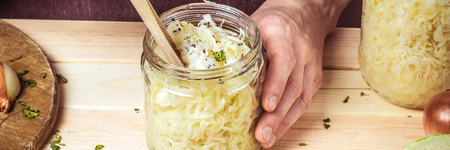
Fermenting vegetables or fruit yourself is very simple! What do you need? Celtic sea salt, water, vegetables (or fruit), sterile jars, and oil. And now? Finely chop your vegetables, place them in a bowl, and generously sprinkle with salt. You might add too much salt, so be sure to taste occasionally. The salt draws moisture out of the cabbage and prevents mould during the fermentation process. After letting the vegetables sit for half an hour, squeeze them with your hands to release more moisture. You can also gently pound them with a pestle. Then place the vegetables in a sterile, airtight glass jar, such as a jam jar or preserving jar, and press them down again with a pestle. Vegetables expand during fermentation, so do not overfill the jars.
Ensure the vegetables are submerged in water. Vegetables like cucumbers, tomatoes, carrots, courgettes, and cabbage release their own juice. After a few hours, they will be completely submerged. For other vegetables, such as cauliflower, you may need to add some water.
Close the jars and leave them at room temperature for at least 3 days. Vent the jars daily. After 3 days, your fermented vegetables are essentially ready. You can also leave them longer to further develop the flavour. Even an opened jar remains edible for months in the refrigerator.
Examples of Fermented Foods
- Sauerkraut (fermented white cabbage)
- Pickles like gherkins, pickled onions, and atjar tjampoer
- Tabasco sauce (spicy sauce made from fermented chillies)
- Worcestershire sauce (British fermented sauce often used as a flavour enhancer in meat dishes)
- Kombucha (fermented tea)
- Kefir (fermented milk or coconut water)
- Tamari (sauce made from fermented soy)
- Fish sauce (Thai sauce made from fermented fish and sea salt)
- Tempeh (meat substitute made from fermented soybeans)
- Kimchi (Korean fermented spiced vegetables)
- Natto (Japanese fermented soybeans)
- Miso (Japanese seasoning made from ground fermented soybeans, forms the base of miso soup)
- Trassi (Indonesian spice paste made from fermented shrimp)
Additionally, unpasteurised yoghurt, sourdough bread, and French cheese are fermented. However, Jesse advises against consuming these products, for reasons that are quite extensive. Curious? Read the following blogs on his website: ‘Do I Have Lactose Intolerance?’ and ‘Is Bread Healthy or Unhealthy?’.
Author: Sanne van der Rijt