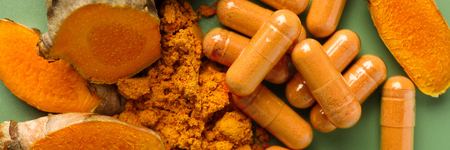
Turmeric supplements: what should you look out for?

The golden-yellow spice turmeric has been a staple of the Ayurvedic tradition for centuries and is widely used in Asian cuisine. Nowadays, turmeric is also popular as a supplement, with various forms available. In this blog, you’ll discover what turmeric is, which variants exist, and what sets liposomal turmeric apart.
What is turmeric?
Turmeric, Indian yellow root, koenier, turmeric or Indian saffron: they’re all names for the same spice. Turmeric is obtained from the colourful root of the plant ‘Curcuma longa’ (Latin name) and is a distant relative of ginger. Turmeric is a popular culinary spice and is widely used within Traditional Chinese Medicine (TCM) and Indian Ayurveda for a range of health purposes.
What does liposomal mean?
In the intro, you briefly read about liposomal turmeric. But what is liposomal? The term ‘liposomal’ comes from Latin, in which ‘lipos’ means fat. Liposomes are microscopic little spheres with a lipid (fatty) outer layer. These liposomes encapsulate nutrients, protect them from, among other things, stomach acid, and help ensure that none of these substances are lost in the digestive tract. Liposomes provide a slow, gradual release of the active ingredients and are absorbed 6 to 10 times better than, for example, capsules, tablets, tea and powder. Sounds good, doesn’t it?
What is turmeric good for?
Adding the spicy, bittersweet note of the golden-yellow spice turmeric to your dishes is always a good idea. For your taste buds and your health! Because:
- Curcuma supports the liver’s cleansing function*
- Curcuma has antioxidant properties*
- Curcuma contributes to the normal function of the immune system*
- Curcuma: helps maintain supple joints and contributes to the maintenance of strong bones*
- Curcuma supports heart function and circulation*
- Curcuma plays a role in digestion*
*Health claim(s) pending approval by the European Commission
The active substance in turmeric is curcuminoids. Curcuminoids consist of 80% curcumin, as well as demethoxycurcumin and bisdemethoxycurcumin. The yellow powder we use as a flavour, aroma and colour enhancer in a dish such as curry contains 2.5% curcuminoids. In turmeric supplements, this percentage is much higher. Want to know more? Read everything about turmeric here.
Is liposomal turmeric the best?
Liposomal supplements are becoming increasingly popular. And for good reason. The secret behind this targeted technique is the use of liposomes as a carrier. As mentioned earlier, liposomes are small particles with a fatty layer (lipids). You’ll find these lipids in our bodies at cellular level, namely in cell membranes. Put simply, a cell membrane is the outer layer of a living cell. Everything that needs to enter the cell must pass through the membrane. The membrane selects which substances are allowed through and which are not, meaning it is selectively permeable.
How does this work when you take turmeric in liposomal form? The curcuminoids (curcumin particles) are contained within the supplement inside the liposomal spheres. When the liposomes containing the curcumin particles come into contact with a cell membrane in your body, the liposome membrane fuses with the cell membrane and the contents of the sphere are released into the cell. In other words, the active substances pass directly through the cell membrane into the body’s cells. This ensures maximum absorption and utilisation without unnecessary loss of, in this case, curcuminoids.
This means that liposomal turmeric supplements can be more effective than other forms of turmeric, allowing you to benefit optimally from the advantages.
Benefits of liposomal turmeric versus other forms
Curcumin, a component of turmeric, is known to offer many health benefits when taken. But your body still needs to absorb the nutrient properly. And curcumin is notoriously difficult to absorb. That’s a major advantage of liposomal turmeric supplements compared with other ways of taking it.
Research findings on the effects of liposomal turmeric are promising. For example, the bioavailability (the ‘degree of absorption’ by the body) of certain liposomal turmeric supplements appears to be 6 to 10 times higher than that of ‘standard’ turmeric supplements.
Because liposomal supplements are absorbed so well, a low dosage is often sufficient. In most cases, 1 capsule per day is enough, which is of course very practical. Liposomal products are often slightly more expensive than standard supplements, but more than pay for themselves thanks to their much better absorption and effectiveness.
Do you find it difficult to take tablets or capsules? Then liposomal turmeric in liquid form is a perfect solution!
Turmeric tea, powder, tablets or capsules?
Does the arrival of liposomal turmeric mean you should stop using turmeric tea, powder, tablets and capsules from now on? Fortunately not. Besides curcumin, turmeric also contains vitamins, minerals and fibre, although these are present in smaller amounts. Curcuma longa is rich in vitamin C, vitamin A and carotene, vitamin B1 (thiamine), B2 (riboflavin), B3 (niacin), B5 (pantothenic acid), biotin, choline, vitamin B6 (pyridoxine), folic acid, inositol, vitamin E (tocopherol), vitamin K and much more. In addition, turmeric contains minerals such as iron, potassium, manganese, magnesium, sulphur, iodine, selenium, silicon, chromium and zinc.
It really depends on what your (health) goal is. If you enjoy the taste of turmeric, then the root, powder or tea is absolutely fine. It’s just not the case that adding turmeric powder to your curry, smoothie or tea will provide enough curcumin.
Buying turmeric? Here’s what to look out for!
Are you curious about what a liposomal turmeric supplement could do for you in supporting your health? Keep the following in mind when choosing a turmeric supplement:
-
Amount of active curcumin
Do you want to use a turmeric supplement to help you achieve your health goal? Then it’s important that the supplement contains the three types of curcuminoids (curcumin, bisdemethoxycurcumin and demethoxycurcumin). The percentage of curcuminoids in a turmeric root or powder, for example, is fairly low. Can’t find the percentage of curcuminoids on the label? In that case, it’s probably ground turmeric root.
-
Bioavailability
Taking a turmeric supplement doesn’t automatically mean the active substances actually reach your cells to do their job properly. Bioavailability refers to the extent to which body cells absorb substances or nutrients effectively. A liposomal turmeric supplement greatly increases this absorption and is therefore recommended in this case!
-
With or without black pepper
Adding piperine (black pepper extract) increases the bioavailability of curcumins. Research shows that when a nutrient is combined with this black pepper extract, the body absorbs more of that nutrient.
-
Value for money
Have you found an affordable turmeric supplement? Then it’s wise to check the recommended daily amount. Thanks to the high absorption of liposomal turmeric supplements, the recommended daily dose is often low. With 1 capsule per day, for example, in most cases you’ll have enough to achieve your health goal. Liposomal products are often slightly more expensive to buy than standard supplements, but they pay for themselves thanks to much better absorption and effectiveness.
Good to know
Using a liposomal turmeric supplement provides a significantly improved bioavailability of curcumin in the body and is much higher than other forms. The liposomal technique ensures that curcumin goes directly into the bloodstream and on to the cells.
Liposomal turmeric supplements are therefore a good solution for anyone looking for a high-quality, well-absorbed supplement with high bioavailability. They are often slightly more expensive to purchase, but because they are absorbed better and you therefore need a lower dose, liposomal supplements usually work out cheaper overall.
Sources
- Nelson, K. et al. (2017). The Essential [...] Chemistry of Curcumin. Journal of [...] Chemistry,10.
- Allam, A. N., El Gamal, S., & Naggar, V. (2011). Bioavailability: A pharmaceutical review. Int J Novel Drug Deliv Tech, 1(1), 77-93.
- Dutta, S. Bhattacharjee, P. (2014). Enzyme-assisted supercritical carbon dioxide extraction of black pepper oleoresin for enhanced yield of piperine-rich extract. The Society for Biotechnology.
- Akbarzadeh A et al. (2013). Liposome: classification, preparation, and applications; Nanoscale Research Letters 8(1):102.
- Sinha R et al. (2018). Oral supplementation with liposomal glutathione elevates body stores of glutathione and markers of immune function. European Journal of Clinical Nutrition 72(1):105-111.