Het verschil tussen prebiotica en probiotica

In de darmen leven miljarden micro-organismen die samen het darmmicrobioom vormen. Misschien heb je wel eens gehoord van prebiotica en probiotica, maar wat is precies het verschil? In dit artikel leggen we uit wat deze termen betekenen en in welke voedingsmiddelen ze voorkomen.
Wat zijn prebiotica?
Prebiotica zijn een soort vezels die je darmen niet verteren. Je vindt prebiotische vezels onder andere in:
- Bananen: rijk aan inuline, een type prebiotische vezel.
- Uien en knoflook: bevatten fructo-oligosachariden, een type vezel
- Asperges: bevatten inuline en andere prebiotische vezels.
- Volkoren granen: zoals tarwe en haver, rijk aan verschillende prebiotische vezels.
- Cichorei en artisjok: goede bronnen van inuline
Meer weten? Lees hier alles over prebiotica.
Wat zijn probiotica?
Probiotica zijn levende micro-organismen, zoals bacteriën en gisten die voorkomen in bepaalde voedingsmiddelen en supplementen. Wanneer je ze via voeding of supplementen inneemt, bereiken deze micro-organisemen via het spijsverteringskanaal je darmen. Meer weten? Lees hier alles over probiotica. Je vindt levende bacteriestammen in:
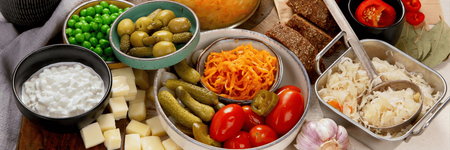
- Gefermenteerde voedingsmiddelen: zoals yoghurt, kefir en zuurkool, die natuurlijke levende culturen bevatten.
- Kombucha: een gefermenteerde thee die rijk is aan levende bacteriestammen.
- Miso en tempeh: gefermenteerde sojaproducten die nuttige bacteriën bevatten.
Wat is het verschil tussen prebiotica en probiotica?
Prebiotische vezels en levende bacteriestammen worden vaak samen genoemd, maar het zijn verschillende soorten voedingscomponenten.
|
Kenmerk |
Prebiotische vezels |
Levende micro-organismen |
|
Wat is het? |
Voedingsvezels |
Levende micro-organismen |
|
Wat gebeurt ermee? |
Worden in de dikke darm door bacterien gefermenteerd |
Worden via voeding of supplementen ingenomen |
|
Waar zit het in? |
Groenten, fruit, volkorenproducten |
Gefermenteerde voeding |
Kun je prebiotische vezels en levende bacteriestammen samen gebruiken?
Wanneer prebiotische vezels en levende bacteriestammen samen worden gebruikt wordt dit ook wel een synbioticum genoemd. Deze combinatie komt voor in verschillende voedingsmiddelen en supplementen waarin zovwel vezels als levende micro-organisemen aanwezig zijn.
Goed om te weten
Prebiotische vezels en levende bacteriestammen worden vaak samen genoemd, maar het zijn verschillende soorten voedingscomponenten.
Bronnen
- Nederlandse Voedingssupplementen Industrie. (z.d.). Wat is het verschil tussen pre-, pro- en postbiotica? Geraadpleegd op [datum], van https://www.ivg-info.nl/voedingssupplementen/overig/probiotica/wat-is-het-verschil-tussen-pre-pro-postbiotica/
- Foster, J. A., Rinaman, L., & Cryan, J. F. (2017). Stress & the gut-brain axis: Regulation by the microbiome. Neurobiology of Stress, 7, 124-136.
- Benedict, C., Vogel, H., Jonas, W., Woting, A., Blaut, M., Schürmann, A., & Cedernaes, J. (2012). Gut microbiota and sleep-wake regulation. Current Opinion in Clinical Nutrition & Metabolic Care, 15(6), 571-577.
- Leclercq, S., Matamoros, S., Cani, P. D., Neyrinck, A. M., Jamar, F., Starkel, P., & de Timary, P. (2017). Intestinal permeability, gut-bacterial dysbiosis, and behavioral markers of alcohol-dependence severity. Proceedings of the National Academy of Sciences, 111(42), E4485-E4493.
- Hempel, S., Newberry, S. J., Maher, A. R., Wang, Z., Miles, J. N., Shanman, R., ... & Shekelle, P. G. (2012). Probiotics for the prevention and treatment of antibiotic-associated diarrhea: a systematic review and meta-analysis. JAMA, 307(18), 1959-1969.
- Clarke, S. F., Murphy, E. F., O'Sullivan, O., Lucey, A. J., Humphreys, M., Hogan, A., ... & Cotter, P. D. (2014). Exercise and associated dietary extremes impact on gut microbial diversity. Gut, 63(12), 1913-1920.
- Gibson, G. R., Hutkins, R., Sanders, M. E., Prescott, S. L., Reimer, R. A., Salminen, S. J., ... & Reid, G. (2017). Expert consensus document: The International Scientific Association for Probiotics and Prebiotics (ISAPP) consensus statement on the definition and scope of prebiotics. Nature Reviews Gastroenterology & Hepatology, 14(8), 491-502.
- Zaib, S., Hayat, A., & Khan, I. (2023). Probiotics and their Beneficial Health Effects. Mini-Reviews in Medicinal Chemistry, 24(1), 110–125.
- Health benefits of probiotics. (1998, October 1). PubMed.
- Latif, A., Shehzad, A., Niazi, S., Zahid, A., Ashraf, W., Iqbal, M. W., Rehman, A., Riaz, T., Aadil, R. M., Khan, I. M., Özogul, F., Rocha, J. M., Esatbeyoglu, T., & Korma, S. A. (2023). Probiotics: mechanism of action, health benefits and their application in food industries. Frontiers in Microbiology, 14.
- Bodke, H., & Jogdand, S. (2022). Role of probiotics in human health. Cureus.
- Ford, A. C., Quigley, E. M., Lacy, B. E., Lembo, A. J., Saito, Y. A., & Schiller, L. R. (2014). Efficacy of prebiotics, probiotics, and synbiotics in irritable bowel syndrome and chronic idiopathic constipation: systematic review and meta-analysis. The American journal of gastroenterology, 109(10), 1547–1561.
- Miller, L. E., Zimmermann, A. K., Ouwehand, A. C., & Hashemi, R. (2017). Effects of an oligosaccharide mixture on constipation and on the composition of the intestinal microbiota of elderly persons. Nutrients, 9(7), 773.